Planetizen
Keep Calm. Carry On. AVs Are Just the End of Parking.
2022
Research into practice
William (Billy) Riggs is a professor, urbanist, and researcher working across cities, technology, mobility, and public policy.

$1M+
Research & student support secured at USF
$2.2B
UC Berkeley building portfolio supported as Principal Planner
200+
Presentations & invited engagements
3 books
Authored books, plus a forthcoming Cambridge contribution
Streets, public space, and the built environment as things to be designed, delivered, and operated.
Automated mobility, Physical AI, and civic technology tested against how cities actually work.
Programs, accreditation, governance, and partnerships that give organizations the capacity to act.
Research carried through to policy, procurement, training, and deployment with public partners.
Writing
Working theses and published writing on technology, design, and the institutions that decide what actually gets built.
Research & Tools
Funded work with Waymo, Cruise, the Mineta Transportation Institute, and the City of Oakland — automation, curbs, transit, climate investment, and street performance.
What does it take for automated systems to operate well in real cities?
Rider perceptions of safety and comfort, transit integration, curb allocation, accessibility policy, and the governance of automated services in shared public space.
What can we learn when cities become measurable at street resolution?
StreetOps and related computational methods for modeling street and curb operations, alongside digital transformation work with public agencies.
How should the street perform as shared civic infrastructure?
One-way to two-way street conversion, street livability, and curb management as an operational discipline rather than a static right-of-way question.
What actually changes how people move?
Social nudges, incentives, and behavioral interventions in travel and energy choices, tested in field and pilot settings.
Who benefits when cities invest in climate resilience?
Transformative Climate Communities work with the City of Oakland and the California Strategic Growth Council, and contributions on net-zero and resilient infrastructure.
Signature open framework
An open computational framework for modeling how streets and curbs actually operate: allocation, conflict, throughput, and access. It underpins curb data specification work with automated vehicle operators and street performance analysis with cities.
Leadership
Good institutions do not simply study change — they rehearse it. My leadership approach connects research, teaching, industry, government, entrepreneurship, and place into a single operating model, so that what students learn, what faculty publish, and what cities deploy reinforce one another.
Leadership in depthProfessor and program director/chair work at the University of San Francisco, spanning public administration, engineering, management, and entrepreneurship and innovation.
Leading NASPAA accreditation and self-study, with participation in AACSB, ABET, and WASC processes across professional and technical programs.
Founder and director of Autonomous Vehicles & the City, a platform connecting research, policy, training, and consulting on automated mobility.
Former Principal Planner at UC Berkeley, working with campus leadership on design review, major capital projects, and a multi-billion-dollar building portfolio.
Faculty governance, conference organization, and external partnerships with cities, industry, and international consortia that outlast any single grant.
Platform · Founded & led by William (Billy) Riggs
A platform for research, policy, training and consulting.
AV&City brings together researchers, policymakers, industry leaders, practitioners, and communities to understand how automated mobility and Physical AI can contribute to better cities — not as a technology showcase, but as an honest assessment of what works, what fails, and what cities should require.
Research
Peer-reviewed studies and open evaluation methods
Training
Executive and practitioner programs for public agencies
Policy
Frameworks for state, regional, and municipal governance
Consulting
Deployment strategy for cities, operators, and investors
Books
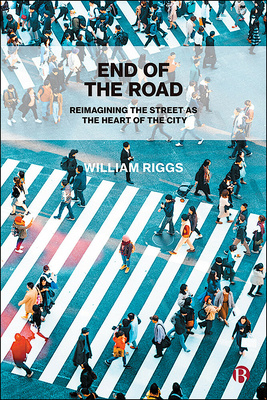
Authored · Bristol University Press
Reimagining the Street as the Heart of the City
A case for the street as the most valuable public space a city owns, and a practical program for redesigning it around people, commerce, and civic life rather than throughput alone.
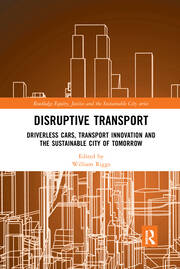
Edited volume · Routledge
Driverless Cars, Transport Innovation and the Sustainable City of Tomorrow
An edited collection — edited by William Riggs — on how automation, shared mobility, and new business models reshape travel behavior, land use, and the policy choices cities must make well before the technology fully arrives.
Contributor · Cambridge University Press
Contributing author among many
A multi-author volume on decarbonization, adaptation, and the financing and governance models required to deliver resilient urban infrastructure at scale.
Speaking & Media
Recent keynotes in Ghent, Amsterdam, Washington DC, and Los Angeles, plus regular commentary for national and international press.
Recent talks
AI and the Future of Cities
ACSP, Pittsburgh, USA
Automation and the City
Third International Conference on Clean Mobility and Energy, Ghent, Belgium
Automation & the Future of Mobility
VerdeXchange, Los Angeles, USA
AV Readiness
Alameda County Conference of Mayors, Hayward, USA
Autonomous Vehicles & the City Symposium
AV&City Symposium, San Francisco, USA
Selected media
De Correspondent
Article · Aug 3, 2026
The San Francisco Standard
Article · Jul 10, 2026
Western City
Article · Jul 6, 2026
Autonomy Insiders
Podcast · Jun 9, 2026
California Sun
Podcast · May 14, 2026
Work With Me
Selective engagements with universities, public agencies, industry, and foundations.
Dean, director, and provost-level engagements: interdisciplinary program design, accreditation strategy, faculty governance, research infrastructure, and organizational models that hold together across departments.
Universities, schools, research institutes
Co-designed studies with cities, agencies, industry, and international consortia — readiness assessment, pilot evaluation, curb and street operations, and multi-year funded programs.
Agencies, foundations, industry labs
Strategic counsel on automated mobility, curb and street operations, civic technology deployment, and the policy and procurement frameworks that decide whether a pilot becomes a service.
Cities, operators, investors
Keynotes, workshops, and multi-day executive programs for leadership teams navigating technological and institutional change, built around decisions rather than trend reports.
Conferences, boards, leadership teams